


 |
Technologies of wood processing.
|
Before processing wood it is necessary to find suitable natural materials in
which shapes it is possible to see artistic images, then manufacturing of forest
sculptures consists in revealing of imaginative plans of the nature without
changing of original images which are incorporated in natural materials.
It is necessary to clear the firm pitch layers of wooden tissues from rotten
wood in old tree roots. For this purpose it is possible to use iron brushes and
various knifes without sharp blades. Namely knifes should be not sharpened at
initial processing of natural materials, that knifes could not cut firm wood
layers in old tree roots but could remove rotten wood.
Sometimes it is possible to use a saw and bench axes to remove unnecessary large
fragments of tree roots and to keep only necessary shapes of a future forest
sculpture.
When the rotten wood is removed it is possible to wash the found tree roots with
water or with a strong jet of water that the fine dust of wooden tissues do not
obstruct to perform the future art work, and do not spoil textures of sculptural
shapes.
After that the found and primarily processed tree roots are necessary for
drying.
-
 |
The further methods of wood processing depend on
personal skills and art ideas of these or those artists and sculptors,
but in any case conceptual art tasks of sculptors consist in keeping
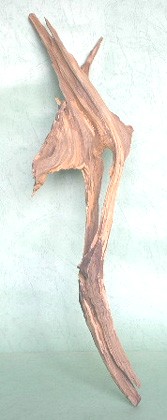
primary natural images and original shapes of forest sculptures. To change initial natural shapes and original forms of the nature it is possible only if such corrections are justified for reasons of artistic ideas which do not deny art concepts of forest sculptures in a context of the fine arts. Further for wood processing of dry tree roots it is possible again to use various iron brushes or knifes and cutters which in this case have sharp blades, but only when sharp cutting tools are really necessary for art work with natural shapes of forest sculptures. Namely in the case when wooden structures of tree roots and future sculptural images demand cutting wood processing. Some old roots of forest fir-trees have very firm wooden structures in pitch layers which can be processed by iron brushes, and some fir-tree roots have soft wooden structures which are necessary for wood processing by means of cutting tools. It means that soft wood structures are necessary for accurate cutting if it is necessary to clear surfaces and outlines of firm wood. For this purpose cutting tools should be ideally sharp. Besides sharp tools are necessary for corrections of inexact shapes which can be changed to form sculptural images of existing natural materials more precisely to animalistic figures of birds or other animals. When any artistic image of a forest sculpture is finally cleared it is necessary to reveal surface textures of wood, namely it is necessary to do surface wood processing by means of an emery paper. And after that it is possible to use different wood stains and other polishes due to which surface textures of wood get a desirable polish appearance. The
photo shows the cleared but not processed root of fir-tree. |
Then the forest sculpture should find any fixed position in space, and should
be fixed harmoniously. Namely it is necessary to install sculptural shapes on a
stand basis (pedestal) or to fix on any other basis which should form an art
composition together with an artistic image of a sculpture, that should
strengthen impression of natural wood and original tree roots.
In essence the basis of a forest sculpture should have a rough natural origin
but should be carefully processed. It is possible to suppose cracks and rough
breaks which emphasize spontaneity of natural tree structures during wood
processing.
Basis installations of forest sculptures depends on art plans of sculptors and
can seem insignificant, but nevertheless harmonious perception of artistic
images in many respects depends on correctly chosen basis.
Forest sculptures of this online gallery have bases installations which are
natural outgrowths and various stumps or other wood shapes of forests. And the
shown wood birds are fixed on pedestals by means of iron dowels and composite
glue. Suspension brackets in wall sculptures are made with copper.
In some cases the shown forest sculptures in gallery are made of several
tree roots which are connected by composite glue and form uniform images. For
example, one root has wings and tail feathers but has no a head, and other root
has shapes of a head which in connection with wings and tail feathers can form
an integral art image of a bird. Such integral forest sculptures are less unique
rather than sculptural shapes which made of one root of a tree, but such
integral animal images are justified from the art point of view.
Among the shown sculptures in this online gallery there are two integral
fir-tree roots: PONIKNA (sad bird) to which the head
is pasted, and OSTROHVOST (sharp-tail bird) to which
the tail is pasted.
Also the integral sculpture is CVADRAKRYL which forms
the four-winged bird.
Sometimes the used fir-tree roots have some fragile parts which are expedient
for firming by means of undistinguished wooden inserts during wood processing.
Such inserts have no disfigure values as tree roots are intact and has unique
art value, but wooden inserts are necessary to keep integrity of sculptural
shapes.
The insignificant insert is used for strengthening wings of the sculptural
bird which is named with poetic name as UTREN (morning
songbird). This root is strong but it seemed to me that the firm insert was
necessary to protect from damage this unique wood shape.
In no event and under any conditions it is impossible to use a varnish. The
wood processing should be natural because application of a varnish makes forest
sculptures artificial.
If it is necessary to process and to protect wood surfaces from influences, it
is better to use not a varnish but other means. Namely I have noticed that if to
saturate a wood with glue "pva" (polyvinyl acetate), which is dissolved with
water in necessary proportions, and by that to strengthen sculptural surfaces by
means of glue, and next if to saturate a wood with a alcohol based stain then
the effect of such processing reminds varnishing.
The birds KORSHUN (kite) and
KLUVEN (beak bird) in this online gallery are
processed by means of such way, but it is made because structures of wooden
tissues of these fir-tree roots in some parts are not equally firm. Therefore
surface wooden tissues are strengthened by glue. But surfaces of wooden shapes
are open and has a natural appearance in other forest sculptures in this art
gallery.
-
The listed technologies of wood processing are applicable to roots of
fir-trees as I use this natural material for manufacturing of forest sculptures,
but really each artist or sculptor can use own methods and technologies of art
works.
Information on different kinds of forest sculptures and various methods of wood
processing can be published on this website if such information will be
necessary to publishing.
And also I can publish links on other websites or online galleries where methods
of manufacturing and art principles of forest wood sculptures are published.
In particular I bring to your attention the information about outgrowths of bird cherry trees which can be used for wooden vases or other art works of natural materials.